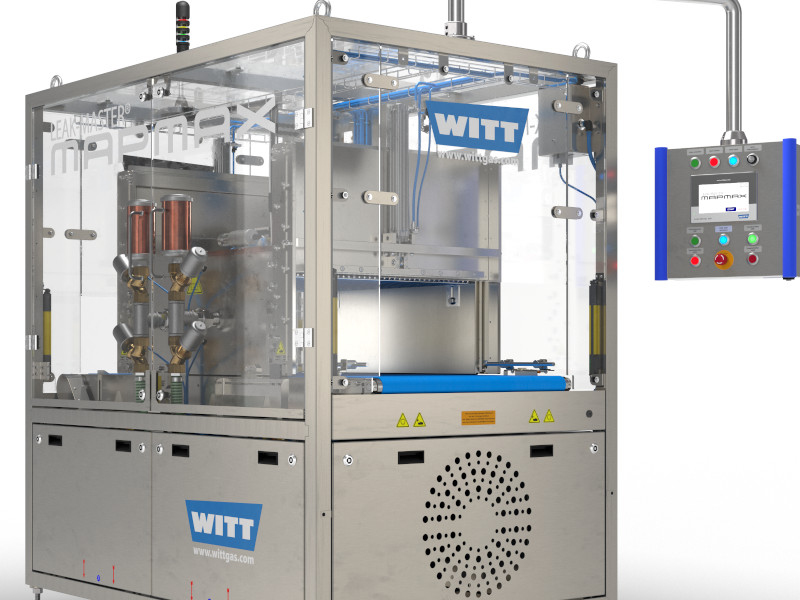
WITT has introduced a new generation of its LEAK-MASTER® MAPMAX inline leak testing system, aiming to help food producers achieve fully leak-proof packaging across their entire production output. The updated system is designed to test every package automatically and non-destructively directly on the packaging line, addressing growing quality, safety and compliance requirements in food packaging operations.
Leak integrity remains a critical issue for food manufacturers, particularly for products packed under modified atmosphere packaging (MAP). Even a single undetected leak can compromise shelf life, trigger product returns and damage brand trust. According to WITT, the LEAK-MASTER® MAPMAX is engineered to eliminate such risks by enabling 100% inline testing of packaging without interrupting production flows.
The system performs leak tests using a CO₂-based method inside a vacuum chamber. By creating a pressure differential, any CO₂ escaping from defective packaging can be detected within fractions of a second. WITT states that the system can identify leaks as small as approximately 20 micrometres, allowing detection of defects that are invisible to visual inspection or conventional sampling-based quality checks.
Designed for integration directly into packaging lines, the MAPMAX can test individual packs, grouped sets, outer packaging or complete cartons. Depending on parameters such as leak size thresholds, CO₂ concentration inside the pack and ambient conditions, the system is capable of reaching testing speeds of up to 15 test cycles per minute. This throughput enables food producers to test all output rather than relying on random or batch sampling.
At the core of the system is a flow-optimised machine design that channels escaping gas towards highly sensitive infrared sensors. WITT specifies that these sensors operate with a resolution of 1 part per million, allowing reliable identification of even minimal gas losses. Leaking packages are detected before leaving the production line, reducing the risk of defective goods reaching downstream logistics or retail stages.
A key feature of the LEAK-MASTER® MAPMAX is its non-destructive testing approach. Because packages remain intact during inspection, manufacturers avoid rejects caused by testing itself, as well as the need for rework or repackaging. In the event that a leak is detected, the system can communicate with downstream equipment via potential-free contacts, enabling automated responses such as alarms or ejection of faulty units.
WITT has also revised the mechanical and ergonomic design of the latest MAPMAX generation. The updated machine features a transparent acrylic glass enclosure, providing improved visibility of the testing process for operators and maintenance personnel. A slimmer footprint reduces space requirements on crowded production floors, while the revised construction is intended to simplify servicing during ongoing operations.
System operation is managed via a touch-screen interface, allowing users to call up predefined settings or adjust test parameters as required for different products or packaging formats. For manufacturers focused on digital quality assurance and traceability, the system includes an Ethernet interface to support data integration into broader quality management systems.
The company positions the new MAPMAX as an evolution of a platform that has already been established in the market for several years. While the underlying testing principle remains unchanged, WITT indicates that the latest version improves usability and operational practicality while maintaining the same level of measurement accuracy.
By combining high sensitivity with inline testing speed, WITT describes the LEAK-MASTER® MAPMAX as particularly suited for applications where entire cases, cartons or individual packages must be inspected without exception. The company argues that this capability supports food producers in protecting product quality, meeting contractual delivery requirements and maintaining consumer confidence in packaged food products.