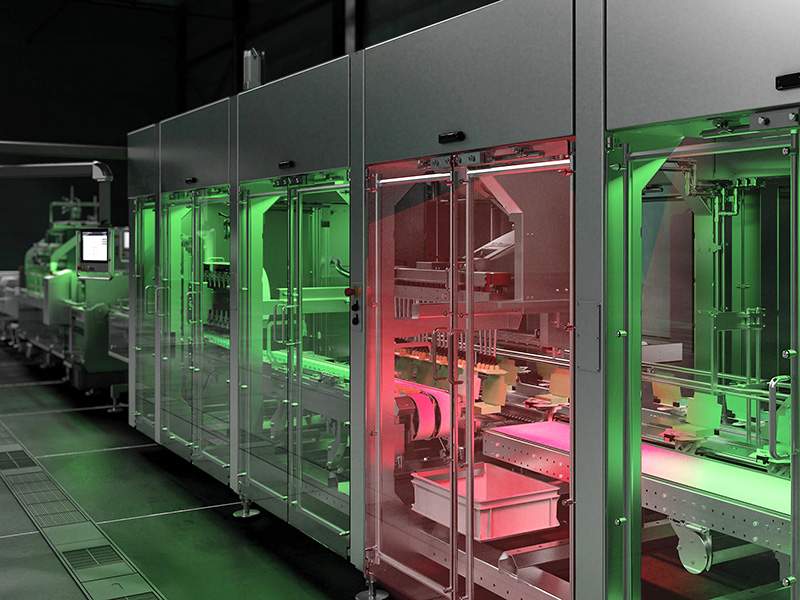
Syntegon is using interpack 2026 to introduce neXt, a new system architecture that brings together machine platforms, digital tools and automation into what it describes as a broader operational concept for the food packaging plant of the future.
Rather than positioning neXt as a single machine launch, the Stuttgart-based company is framing it as an integrated packaging ecosystem built around three principles: seamless operation, smart decisions and touchless automation. The approach is designed to address a set of pressures now affecting food manufacturers across production environments, including rising operating costs, labour shortages, stricter safety and compliance demands, and growing packaging complexity.
At the centre of the launch are two new machine platforms that serve as core elements of the new architecture: the HFX flow-wrapping platform for primary packaging and the TRX topload cartoning platform for secondary packaging. Both have been developed as modular systems that can be integrated into a broader packaging line structure, with Syntegon also stressing retrofit capability and scope for later upgrades.
The company’s argument is that packaging lines can no longer be judged only by individual machine performance. Instead, manufacturers increasingly need harmonised systems that reduce downtime, simplify changeovers, improve operator usability and support more data-driven production management. Syntegon is positioning neXt as a response to that shift.
Under the “Seamless Operation” element of the concept, the emphasis is on standardised interfaces, common operating logic and a uniform approach to format changes across machines connected within the system. The aim is to make it easier for operators to move between different machines, reduce errors and shorten set-up times.
That logic is reflected particularly in the new TRX topload cartoning platform, where guided or automated processes are designed to enable format changes in around ten minutes. Syntegon also says the platform reduces the number of format parts required, which could lower both downtime and format-related investment costs. In practical terms, that also points to a reduced dependence on highly experienced operators at a time when packaging operations across the food industry are finding skilled labour increasingly difficult to secure.
The second pillar, “Smart Decisions”, extends the focus from mechanics to line intelligence. Syntegon says neXt links connected machine platforms with software tools including its cloud-based Synexio environment, machine-based logbook functions and 3D error views. The idea is to create a production environment in which performance, quality and machine status can be tracked more transparently and acted on more quickly.
Within that framework, camera-based and AI-supported quality control, automated fault detection and status monitoring are intended to reduce unplanned stops, cut waste and improve overall equipment effectiveness. The concept also reflects a broader industry move toward remote supervision and faster intervention, with operators and production managers expected to monitor line conditions in real time and respond before minor deviations become more costly disruptions.
The third element, “Touchless Automation”, focuses on reducing manual intervention in repetitive tasks. Syntegon is presenting this not as a standalone automation add-on, but as a line-level principle within neXt. In this model, autonomous systems handle recurring activities such as supplying packaging materials, while autonomous mobile robots deliver film reels or cardboard blanks to the machines. In flow-wrapping, high-performance splicing systems are designed to support uninterrupted operation.
According to the company, that combination can allow packaging lines to run for extended periods without operator intervention. For manufacturers, the commercial case is tied not only to higher line availability, but also to lower pressure on staffing and a shift of labour toward higher-value tasks.
Syntegon is also linking the neXt architecture to longer-term lifecycle planning. The company says both the HFX and TRX platforms are designed to remain scalable over time, allowing digital functions, automation modules or other features to be added later rather than requiring a complete equipment replacement. That lifecycle positioning is supported by service agreement packages covering maintenance, spare parts and response times, with the stated goal of improving uptime predictability and protecting the long-term value of the investment.
Sustainability and regulatory readiness are another part of the message. Syntegon says the architecture supports energy and waste reduction while also giving manufacturers more flexibility in handling different packaging formats and materials, including those aligned with PPWR requirements. That is becoming an increasingly important issue for food producers and packaging operations needing to adapt machine performance to changing material specifications without sacrificing efficiency.
With neXt, Syntegon is clearly trying to move the discussion beyond single-machine innovation and toward the structure of the packaging line as a coordinated, data-enabled system. The HFX and TRX launches provide the hardware backbone, but the broader message at interpack is about how food manufacturers may need to rethink packaging operations in a more connected, automated and operator-independent direction.