At this year’s interpack in Düsseldorf, conversations around sustainability increasingly moved beyond materials and recyclability targets toward a more fundamental question: how can packaging systems become measurable, traceable and verifiable across their entire lifecycle?
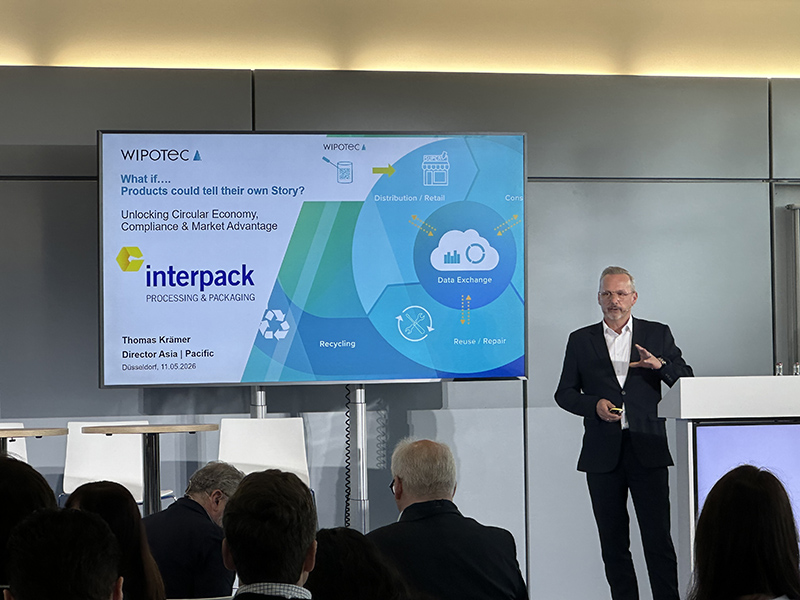
That shift formed the basis of a presentation delivered by WIPOTEC’s Asia Pacific Director Thomas Krämer, who explored how digital product marking, serialization and connected product identities are beginning to reshape circular economy strategies across manufacturing and packaging operations.
The concept starts with a simple proposition: products should not only protect, transport and communicate — they should also carry information about themselves.
For years, circular economy discussions have focused heavily on materials and end-of-life recovery. Yet a growing challenge has emerged across industries: products and packaging often become effectively anonymous once they enter the market. Information about composition, origin, environmental footprint or recycling pathways is frequently fragmented or lost entirely.
According to the presentation, this lack of transparency creates a structural barrier to circularity. Without access to reliable product information, recycling efficiency suffers, sustainability claims become difficult to validate and stakeholders across the value chain struggle to make informed decisions.
Circular Systems Require Data, Not Just Better Materials
The presentation argued that moving from a linear “take–make–waste” model toward circular business models requires more than introducing recyclable substrates.
Instead, circularity increasingly depends on the ability to maintain data continuity throughout the lifecycle of products and packaging.
This includes information such as material composition, product origin, repairability, carbon footprint, recycling instructions and end-of-life scenarios. Access to that information is relevant not only for manufacturers but also for retailers, recyclers and consumers.
Digital product identities are emerging as one possible mechanism to create that continuity.
Through technologies such as printed codes, laser marking and connected databases, physical products can be linked to digital information layers that remain accessible throughout production, distribution, use and recovery.
Rather than functioning as isolated physical units, products become part of a broader information ecosystem.
A single scan can provide access to a digital history of the product and its packaging.
Product Marking Moves Beyond Production Requirements
Historically, marking technologies have often been associated with production control, coding or supply chain management.
However, the presentation suggested their role is expanding.
Digital product marking increasingly supports multiple business objectives simultaneously: traceability, sustainability reporting, regulatory readiness and consumer interaction.
According to Krämer, one identifier can generate lifecycle data, support compliance activities and create direct digital touchpoints with consumers.
As he summarised during the presentation: “Small Keys can open Big Doors.”
That positioning reflects a broader industry trend where packaging data is starting to be treated less as an operational output and more as strategic infrastructure.
Regulation Is Accelerating The Need For Digital Transparency
The growing focus on digital identities also aligns with regulatory developments taking shape across Europe.
The presentation referenced emerging requirements under the Packaging and Packaging Waste Regulation (PPWR) and the Ecodesign for Sustainable Products Regulation (ESPR), both of which are expected to increase expectations around verifiable environmental and product information.
Under these frameworks, manufacturers are expected to provide clearer information related to recyclability, material composition, environmental performance and lifecycle characteristics.
Digital Product Passports (DPPs) are increasingly positioned as one of the mechanisms capable of supporting those requirements.
In that context, marking technologies become more than an identification layer.
The presentation argued that product identity increasingly underpins the wider compliance chain: identity enables data collection, data enables traceability, and traceability supports regulatory alignment and continued market access.
Beyond Compliance: Creating Value Through Connected Packaging
The presentation also highlighted that some companies are already exploring digital identities as tools for broader business transformation rather than purely regulatory preparation.
One example referenced was Coca-Cola’s RefPET serialization initiative, presented as a case of combining recycling support, product traceability and consumer engagement through connected product systems.
The broader commercial opportunity lies in extending packaging beyond its physical function.
Connected packaging can potentially support transparency around sourcing, communicate sustainability information more effectively and offer guidance on reuse, repair or disposal pathways.
For consumers increasingly looking for verifiable environmental claims, digital interaction may become an important trust-building mechanism.
The presentation described this shift as transforming products from “black boxes” into “open windows” — creating visibility across supply chains that historically operated with limited information exchange.
Building The Foundations Of Circular Packaging
For packaging producers, converters and brand owners, the message from interpack was that circularity is becoming inseparable from data availability.
Material innovation remains important, but increasingly it must be accompanied by systems capable of carrying reliable information across the value chain.
Whether through serialization, QR-enabled packaging or future Digital Product Passport architectures, the underlying requirement remains the same: products need identities before they can become truly circular.
As regulatory frameworks evolve and expectations around sustainability become more measurable, the competitive distinction may no longer come from who can claim transparency — but from who can demonstrate it.