As packaging operations become more complex, manufacturers are increasingly shifting their attention from individual machine performance to how entire production lines function as connected systems.
Higher SKU counts, changing packaging formats, evolving material requirements and pressure to improve throughput are making end-of-line performance a more strategic consideration across manufacturing environments. Rather than pursuing large-scale replacement projects, many producers are looking for ways to introduce automation incrementally while maintaining compatibility with existing infrastructure.
This changing environment is creating opportunities for equipment suppliers and system integrators that focus on flexibility, interoperability and phased deployment.
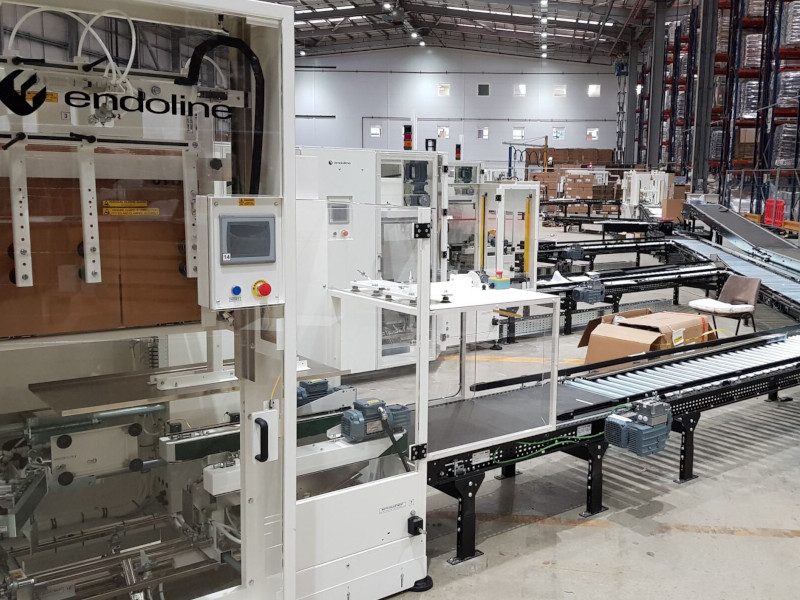
Among those positioning around this trend is Endoline Automation, whose portfolio of semi- and fully automated case erecting, packing and sealing systems is designed to support integration into existing production environments rather than requiring complete line redesigns.
According to the company, one of the recurring challenges in end-of-line projects is balancing current operational requirements with the need to accommodate future changes in packaging formats and production volumes.
System integrator Montech, which works with Endoline, points to scalability as an increasingly important requirement in automation projects.
“With the growing complexity of production environments, the ability to scale systems is becoming even more key to successful integrations. Long-term partnerships are especially critical for continuity when investments are spread out,” said Tom Vanderheyden, Sales Director at Montech. He added that integrators increasingly value suppliers that can adapt equipment layouts and configurations to suit specific operational requirements.
Drawing on its project experience, Endoline highlighted several areas that manufacturers and integrators are prioritising when evaluating end-of-line investments.
One of these is planning for variation rather than fixed production assumptions. As packaging lines handle a broader mix of products and case formats, equipment flexibility becomes increasingly important. Endoline argues that the ability to switch between SKUs, accommodate changing case sizes and adapt to different board specifications can reduce the risk of future bottlenecks.
Connectivity is another area receiving greater attention. Integrating new equipment into established production environments can create challenges where machinery cannot communicate with existing manufacturing execution systems (MES) and enterprise resource planning (ERP) platforms. Endoline notes that open connectivity, software support and extensive testing before installation can help reduce commissioning delays and minimise downtime risks.
The company also argues that earlier collaboration between suppliers, integrators and end users can reduce project complexity. Establishing technical specifications and operational requirements before implementation may help avoid redesigns later in the project lifecycle and improve overall equipment effectiveness (OEE).
At the same time, equipment suppliers are placing greater emphasis on support beyond installation. Training, preventative maintenance and ongoing optimisation are increasingly positioned as part of long-term equipment performance rather than optional services.
“The primary value of preventative maintenance is it keeps equipment running at peak performance. Routine checks also extend the lifespan of equipment and help to prevent unexpected breakdowns that can impact line efficiency,” said Andrew Yates, Managing Director of Endoline Automation.
The company also points to modular deployment strategies as an alternative to full-line transformation. By targeting individual stages such as case erection or case sealing first, manufacturers may be able to generate operational improvements while spreading capital expenditure over time.
“Iterative deployment supports continuous improvement. It also reduces the risk of failure,” Yates said, adding that streamlined integration can accelerate return on investment.
As manufacturers continue adapting to more variable production environments, end-of-line integration is increasingly becoming a broader operational issue rather than a standalone equipment decision — with suppliers such as Endoline seeking to position flexibility and scalability as part of the answer.