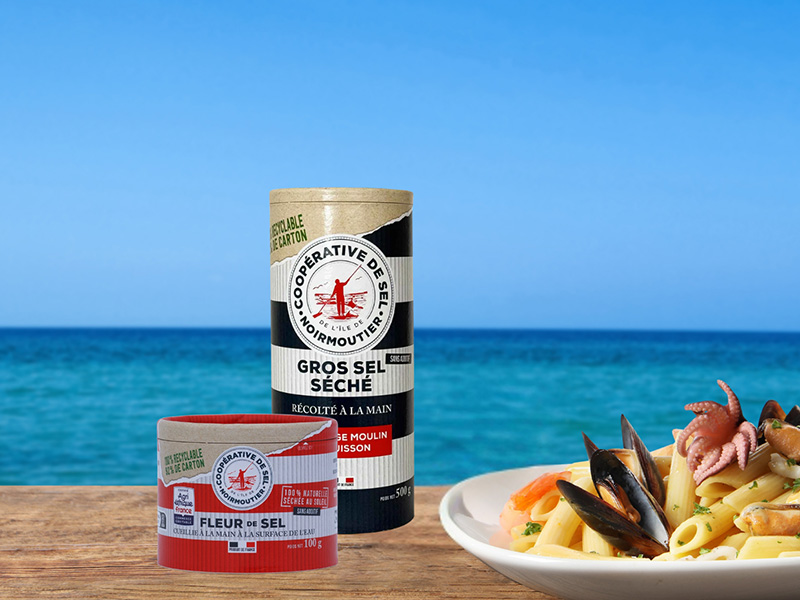
The Noirmoutier Sea Salt Cooperative is moving its Agri-Éthique-labelled sea salt range into Sonoco’s paper-based GreenCan, replacing its previous plastic sprinkler container as it seeks to reduce plastic use and align packaging choices more closely with the values behind the product.
The transition concerns sea salt harvested on France’s Atlantic coast, where the cooperative says hand-harvesting traditions stretch back centuries. In commercial terms, the packaging change is positioned as both a sustainability measure and a practical test of whether fibre-based formats can meet the performance demands of a humidity-sensitive food product.
For the cooperative, the change was framed as a question of consistency between product origin, environmental commitments and packaging choice. “Certified Agri-Éthique, our cooperative is committed to responsibility and coherence in every decision we make,” said Joël Piau, Cooperative Director. “In anticipation of the upcoming PPWR regulation, we wanted to reduce plastic waste by adopting packaging that is more sustainable and genuinely circular. Sonoco’s GreenCan® met our sustainability requirements and allowed us to implement this transition with a solution aligned with our values and our long-term vision.”
The cooperative says the move allows it to replace a plastic format with a high-paper-content alternative that also includes an integrated paper lid. That point is significant in a category where moisture protection remains central to product quality and shelf performance.
Piau said the packaging had to deliver both environmental gains and functional reliability. “GreenCan® combines high paper content with functional performance for demanding food applications. The packaging contains up to 98% paper and incorporates renewable and recycled fibres, while providing the barrier protection needed to preserve product freshness and quality. For hygroscopic products such as sea salt, this balance between sustainability and protection is critical.”
That combination of fibre content and barrier performance is increasingly central to packaging decisions across food categories, particularly where brands are seeking to reduce plastic without introducing handling, storage or shelf-life risks. In this case, the cooperative is linking the packaging shift to the wider philosophy behind Agri-Éthique, the French fair-trade label created in 2013 to support farmers through fair prices and long-term partnerships.
The argument presented by the companies is that responsibility should extend beyond sourcing and production into packaging design and material choice. In that sense, the project is being used not only as a packaging conversion, but also as an example of how brands with strong origin stories are trying to connect sustainability claims across the entire value chain.
Sonoco is also placing the project within the broader market move toward fibre-based packaging. The company points to what it describes as accelerating “paperisation” across multiple product categories, as brands respond to regulatory pressure, consumer expectations and improving material performance.
“Several forces are driving this shift,” said Seàn Cairns, President of Sonoco Consumer Packaging EMEA/APAC. “Consumers have a good perception of paper packaging, especially the younger generations of consumers (GenZ), associating paper packaging with environmental benefits, safety and good value for money. Retailers and brands are getting ready for the Packaging and Packaging Waste Regulation (PPWR), prioritising circular packaging formats. Technological progress and innovations such as Sonoco’s Greencan® are also expanding the possibilities for fibre-based solutions. Advances in packaging design now enable paper formats to protect sensitive products while maintaining product integrity and shelf appeal.”
According to the release, product launches using paper-based packaging formats rose by more than 122% between 2023 and 2025, citing Mintel. The categories referenced include food, personal care and household products, suggesting that the shift is not confined to one segment but part of a wider material transition now influencing packaging development pipelines.
Cairns said the Noirmoutier project showed how packaging is becoming a more explicit part of brand sustainability strategy. “Against this backdrop, the Noirmoutier Cooperative initiative illustrates how heritage food brands can rethink packaging as an integral part of their sustainability strategy — aligning product values, consumer expectations and future regulatory requirements. For Noirmoutier Sea Salt, the transition represents more than a packaging change. It is a way to ensure that a product rooted in one of France’s most iconic coastal landscapes continues to reflect the principles of responsibility and sustainability that have defined it for generations.”
The release also presents the move as a proactive step rather than a compliance-led reaction. The cooperative says it chose to act ahead of regulatory change and undertook evaluations to ensure that improvements in material circularity would not come at the expense of product protection.
That positioning is likely to resonate across the wider packaging sector, where many food producers face the same challenge: reducing plastic intensity while preserving barrier performance, pack functionality and premium shelf presentation. In that context, the Noirmoutier transition is less about a single format change and more about how fibre-based packaging is being tested in product categories where material performance cannot be compromised.