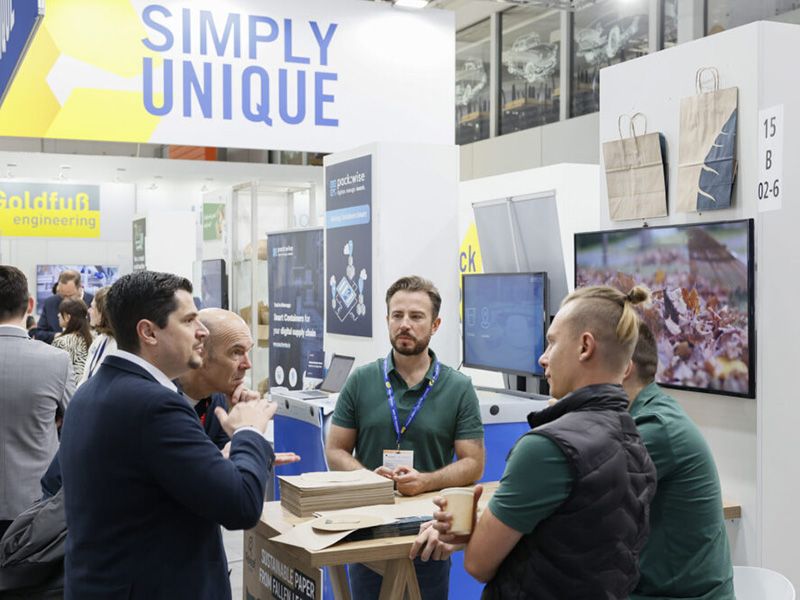
Interpack 2026 will place a strong emphasis on early-stage innovation, with 22 start-ups set to exhibit in a significantly expanded Start-up Zone in Hall 7a. The dedicated exhibition space has more than doubled in size compared to the previous edition, reflecting growing industry interest in emerging technologies and new business models.
The companies, representing eight countries including Germany, Sweden, India, Portugal, South Korea, Austria, Estonia and the UK, will present solutions spanning sustainability, digitalisation, regulatory compliance and process innovation. Their offerings range from bio-based and recyclable materials to reusable systems, healthcare transport packaging and software platforms addressing ESG reporting, PPWR compliance, serialisation and AI-supported operations.
The initiative is positioned as a response to structural shifts across the packaging and processing sectors, where regulatory pressure, cost constraints and sustainability targets are reshaping both materials and systems design. Interpack 2026 itself will run from 7 to 13 May in Düsseldorf, bringing together approximately 2,800 exhibitors from 67 countries.
A number of the featured start-ups are targeting food waste reduction, an area of increasing regulatory focus within the European Union. Sweden-based Innoscentia, for example, is developing sensor technology designed to improve the accuracy of best-before date management.
“Conservative best before date marking confuses consumers and reduces the sales window for retailers adding to the massive global food waste problem,” said Henrik Nilsson, CEO of Innoscentia. “Our sensor technology enables cost-effective quality control for every single package. By displaying the actual quality in real time, shelf life is extended and consumers can make purchasing decisions based on facts. Stricter legislation and binding targets set by the European Union for 2030, which aim to reduce food waste by 10 per cent at the producer level and by 30 per cent in the retail sector and among consumers, require new solutions so that the industry can better respond to the new, stricter legal requirements.”
Similarly focused on shelf-life extension, Portugal-based Nanox will present its Pack Smart technology, which uses functional additives to inhibit microbial growth and regulate gas exchange within packaging.
“Our solutions are developed in compliance with international food-contact regulations and quality standards, enabling safe and scalable adoption across global markets,” said Gustavo Pagotto, CEO and co-founder of Nanox. “By combining material science, regulatory readiness, and industrial feasibility, we help reduce food waste throughout the value chain. Interpack is the ideal platform to connect our innovation with global industry leaders driving sustainability, PPWR adaptation, and next-generation packaging technologies.”
Beyond food applications, several start-ups are addressing challenges in pharmaceutical and temperature-sensitive logistics. Licopharm is developing paper-based insulated packaging systems aimed at replacing conventional plastic and expanded polystyrene (EPS) solutions in cold chain transport.
“In doing so we are addressing the challenge of transporting sensitive goods safely while reducing the use of plastic and EPS packaging,” said Mirko Cyron, Sales Manager at Licopharm. “Our approach combines high-performance, paper-based insulation materials with tailor-made system solutions that ensure stable temperature conditions and are fully recyclable.”
Regulatory developments are also influencing packaging design choices, particularly in relation to preservatives and material composition. Germany-based EVOPACK is focusing on bag-in-box solutions intended to reduce product losses and enable lower preservative use.
“In light of the PPWR and the tightened Biocidal Products Regulation (BPR), the reduction of preservatives is increasingly becoming a competitive factor. We offer manufacturers a future-proof, regulatory-compliant packaging solution that reliably ensures product safety even with reduced or minimal use of preservatives,” said Florian Ebinger, co-founder of EVOPACK.
Material innovation remains another key theme, with Cell2Green introducing a cellulose-based film designed as an alternative to conventional plastics. The material is produced from renewable raw materials, including wood and paper industry waste, without the use of toxic chemicals.
“Our solution is both recyclable and suitable for sensitive applications where films frequently end up in the environment – such as in agriculture, with bio-waste or in consumer-facing packaging. At the same time, the film meets industrial requirements such as moisture resistance, sealability and reliable processing – entirely without additives,” said Dirk Hollmann, CEO and co-founder of Cell2Green.
The Start-up Zone is designed to facilitate interaction between emerging companies and established industry players, including brand owners, converters and equipment manufacturers. In addition to exhibition space, selected participants will present their technologies at the interpack Spotlight Forum, which will host sessions on market trends, smart manufacturing, materials innovation and workforce development.
The broader event programme will also include formats such as Young Talents Day, aimed at connecting early-career professionals with industry stakeholders, and a comprehensive exhibitor showcase covering the full value chain from processing equipment to packaging materials and digital solutions.
By expanding the Start-up Zone and integrating it with knowledge-sharing platforms such as the Spotlight Forum, interpack 2026 is positioning early-stage innovation as a central component of industry transformation, particularly as companies adapt to tightening regulatory frameworks and shifting sustainability requirements.