Gerhard Schubert used interpack 2026 to position modularity as both its core engineering principle and its broader market strategy, combining the launch of a redesigned TLM generation with expanded LIGHTLINE and TOG ranges aimed at faster deployment, lower complexity and more targeted automation investment.
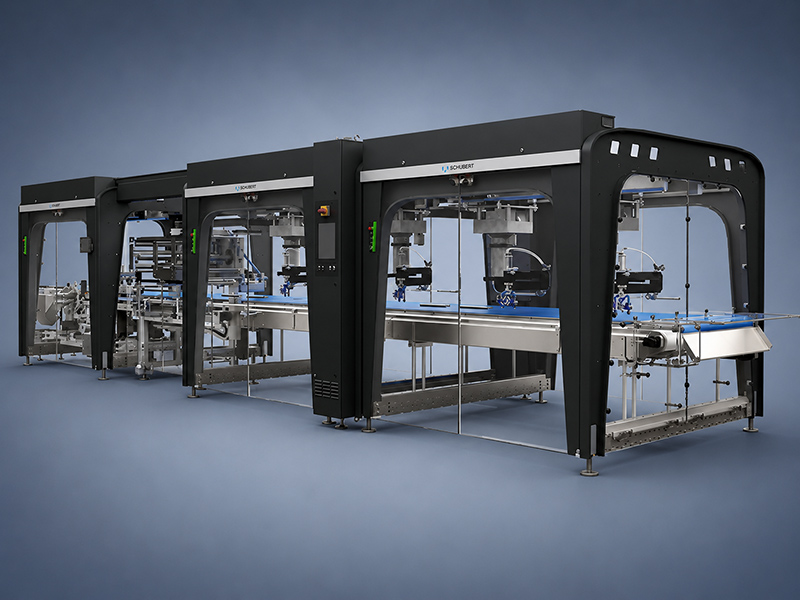
At the centre of Schubert’s Düsseldorf showcase was the new TLM generation, a significant redevelopment of the company’s flagship top-loading machine platform designed to respond to rising customer cost sensitivity, labour shortages and growing competitive pressure. Developed over three years, the system reflects a more aggressive focus on performance, footprint and pricing while preserving the modular architecture that has defined Schubert’s packaging systems.
“The increased cost sensitivity of many customers and the growing competitive pressure from Asia presented us with a significant challenge,” said Manuel Schuster, Head of New Product Development for Assemblies at Gerhard Schubert. “This made us all the more determined to bring a solution to market with the next TLM that underscores our innovative strength as a technology leader, while meeting the high demands on performance, space requirements and price.”
The redesigned TLM introduces a frame that is four times stiffer than previous versions, enabling Schubert’s F4 robots to operate with greater precision at higher speeds through AI-supported path calculation. The system also incorporates Schubert’s twin-pick method, allowing two products to be handled simultaneously, increasing robot-arm performance by 20% while reducing vibration. In addition, self-optimising vacuum pumps cut compressed air consumption by around 30%, targeting meaningful energy savings in picker-line applications.
Schubert also transitioned the new platform to EtherCAT field communication and introduced decentralised tablet-based HMI interfaces, moves that align the system more closely with smart manufacturing demands, operational flexibility and emerging compliance requirements such as the Cyber Resilience Act.
While the new TLM represented the technological headline, Schubert’s wider interpack message focused on broadening how modular automation can be deployed across different customer needs.
“With TLM, the top-loading machines, Schubert has set all-new standards in robotic packaging,” said Marcel Kiessling, Managing Director of Sales and Service.
For more standardised applications, Schubert highlighted LIGHTLINE, a preconfigured machine range designed for manufacturers seeking quicker commissioning and lower project-planning costs. With 90% standardisation, LIGHTLINE targets simpler packaging tasks where speed to production and reduced investment complexity are increasingly important.
“The LIGHTLINE series offers the ideal solution for a line that can be deployed quickly at extremely attractive investment costs,” said Marcus Schindler, Director Strategic Corporate Development.
At the same time, TOG extends Schubert’s modular concept into standalone production cells that address specific packaging functions such as erecting or AI-supported pick-and-place. Rather than requiring full line replacement, TOG is aimed at manufacturers seeking targeted functional upgrades with lower entry barriers.
“Currently, the TOG series consists of our TOG Cobot – a cognitive pick & place robot with in-house AI – and the TOG Erecting Unit box erector. Further production cells will follow,” said Ralf Schubert, Managing Director and Shareholder.
Taken together, Schubert’s interpack 2026 portfolio suggests a deliberate expansion from premium high-flexibility systems into a broader tiered automation model: advanced customised TLM platforms, standardised LIGHTLINE systems and function-specific TOG cells. For packaging manufacturers navigating workforce shortages, cost pressure and increasingly fragmented production requirements, the strategy reflects a supplier increasingly focused not only on machine innovation, but on matching modular automation to varying operational and investment realities.