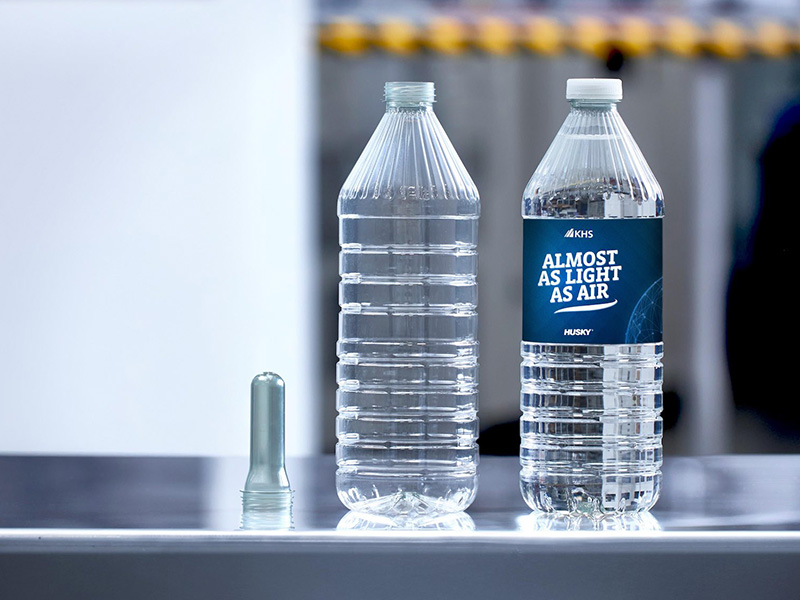
KHS and Husky Technologies have introduced what they describe as one of the lightest PET beverage bottles on the global market—a 591ml container weighing just 5.89 grams. The result is a material reduction of approximately 30% compared to standard lightweight bottles for still water, marking a significant advancement in sustainable bottle design.
The new container, dubbed “Factor 101,” builds on a feasibility study first showcased by KHS at drinktec 2017. Since then, extensive modifications to the shoulder, base, and bottle body have improved mechanical performance without compromising integrity.
“With such extreme lightweighting, what’s known as the top load is especially important,” said Fabian Osterhold, packaging designer at KHS. “This value tells us how sturdy the bottle is from a vertical perspective. It determines whether the container can be stacked or not and survive transportation undamaged.”
To boost rigidity, the bottle’s shoulder geometry has been reengineered and the body reinforced with functional webbing. The base incorporates a “pop-in” feature, which slightly collapses inward under vertical force, raising internal pressure and consequently improving stability. This enables the bottle to withstand a top load of 220 newtons—surpassing the common industry threshold of 200 newtons.
But structural redesign alone was not sufficient. “The preform design also needed to be developed further,” Osterhold noted. This led to KHS collaborating with Husky, whose expertise in preform manufacturing allowed for tighter integration between preform geometry and stretch blow molding parameters.
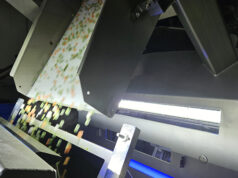
The process required a highly precise approach to temperature control. “Focus lamps in the heater on our InnoPET Blomax Series V, for example, make for extremely precise temperature profiling directly under the bottle neck ring,” said Osterhold. “This ensures that no material stays unstretched. In turn, this considerably reduces the amount of plastic used.”
From a manufacturing standpoint, the new bottle is fully compatible with rPET, adding circularity to its list of benefits. According to KHS, while the standard PET bottle for still water in the U.S. weighs around 7 grams for 500ml, the new design uses less material while offering a higher performance-to-weight ratio.
By reducing material usage and maintaining functionality, the KHS-Husky collaboration demonstrates how integrated engineering between preform and bottle design can significantly contribute to packaging sustainability without sacrificing logistical robustness.