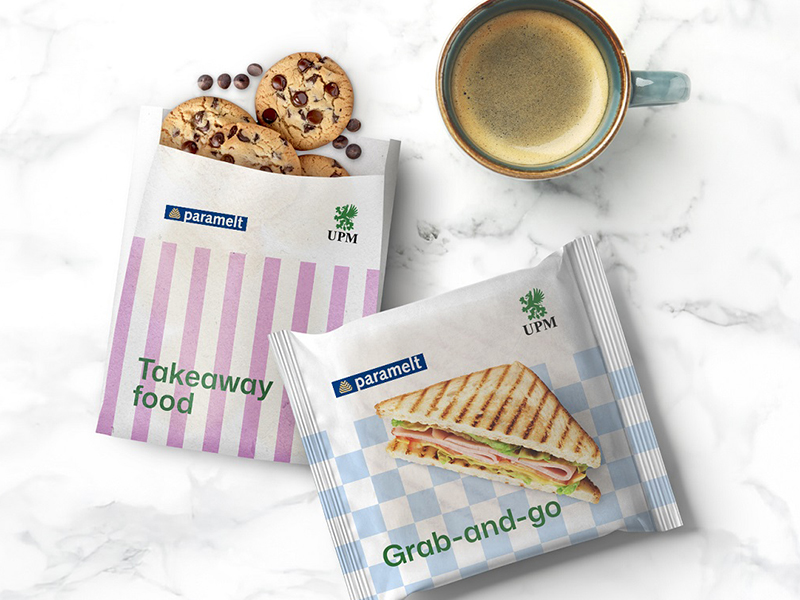
UPM Specialty Materials and Paramelt have introduced a bio-based, paper-based food packaging concept aimed at bakery, fast food and convenience applications, as suppliers continue to develop fiber-based alternatives for food contact formats that require grease resistance and heat-seal functionality.
The concept combines UPM’s barrier base papers with Paramelt’s bio-based heat-seal and barrier coating technology. According to UPM, the individual components have been validated as home compostable, while the overall structure is designed to offer grease protection and improved end-of-life performance.
The material configuration uses either UPM Solide Lucent or UPM Prego as the paper base. Both grades are described as being engineered for use with barrier coatings. These are paired with Paramelt Aquavate Bio SB 2383, a water-based coating formulated exclusively from biodegradable components.
The companies said the development is intended to address packaging needs in foodservice and convenience segments where paper-based formats must deliver functional barriers without undermining processability on existing equipment. A key part of the concept is its compatibility with established packaging infrastructure. The partners said it can be integrated on current converting and packaging lines, including vertical form fill seal operations.
That operational compatibility is likely to be one of the more commercially relevant aspects of the launch. In practice, packaging converters and food manufacturers often face constraints not only around material performance, but also around whether new substrates or coatings can run efficiently on installed machinery without major process changes. UPM and Paramelt said the coating enables low coat weights while maintaining reliable performance, suggesting an effort to balance barrier functionality with material efficiency.
Christiane Laine, Senior Researcher at UPM Innovation, said achieving this level of grease resistance at such low coat weights is highly challenging even when using fossil-based coatings. That claim points to the technical focus of the collaboration, which appears to center on maintaining barrier performance while shifting to biodegradable coating chemistry and paper-based structures.
Paramelt also positioned the concept as a practical route for converters looking to adapt existing operations rather than deploy entirely new systems. Leon Krings, Business Development Manager for Packaging Coatings & Adhesives at Paramelt, said the bio-based coating is designed to perform reliably on standard coating processes and existing converting lines. He added that this could support a transition toward recyclable and home compostable fiber-based packaging solutions.
The development reflects a broader push across the packaging value chain to replace or reduce conventional fossil-based barrier materials in food packaging, particularly in applications where grease resistance and sealing performance are critical. Bakery items, fast food wraps and convenience packaging present a technically demanding use case because they require barrier protection while also needing to function in high-volume converting and packing environments.
Within that context, the UPM-Paramelt concept is positioned less as a single finished pack format and more as a platform material combination: a coated paper structure intended to deliver functional packaging performance while aligning with compostability and fiber-based packaging goals.
No launch volumes, commercial rollout timeline or customer deployment details were disclosed in the material provided. However, the companies’ emphasis on compatibility with standard coating processes and existing packaging lines indicates that the concept is being presented as a near-market converting solution rather than a purely experimental development.