BioSupPack, an EU-funded project coordinated by AIMPLAS, says it has demonstrated that brewery waste can be converted into high-performance bioplastics for packaging applications, with the resulting materials and processes now positioned for industrial uptake across food, cosmetics and consumer goods.
The project, which brought together 18 partners across the PHA and PHB bioplastics value chain, focused on turning brewery spent grains into packaging materials while also developing routes for recovering and recycling those materials at end of life. According to the consortium, the work was carried out over five years and supported by EUR 7.6 million in funding from the Circular Bio-based Europe Joint Undertaking under the EU’s Horizon 2020 research and innovation programme.
The central industrial claim behind the project is that brewery by-products, typically treated as low-value residues, can instead serve as feedstock for bio-based polymers that are closer to commercial packaging performance requirements than earlier development-stage concepts. BioSupPack said it developed and validated six innovation areas at demonstrative scale and in operational environments, targeting what it described as critical challenges facing the packaging industry as it moves toward compliance with the EU Packaging and Packaging Waste Regulation.
Rosa González Leyba of AIMPLAS, the project coordinator, said the consortium had shown that waste valorisation and circular packaging design can be linked in a single system. “BioSupPack has demonstrated that we can create a true circular economy by turning brewery waste into valuable packaging materials and by recycling the packaging waste through innovative recycling technologies like enzymatic recycling. Our consortium has successfully scaled up innovative biorefinery processes and developed biobased materials for rigid packaging for food and non-food applications, obtaining packaging prototypes which are very close to the current counterparts on the market.”
Among the project’s main outputs is a biorefinery process for producing PHB from brewery spent grains. BioSupPack said the process uses plasma pretreatment and microbial fermentation to convert the waste stream into high-purity PHB, reaching Technology Readiness Level 6. The consortium presented this as an example of industrial symbiosis between breweries and bioplastics producers, with the intention of creating a more robust feedstock base for bio-based packaging materials.
The project also reported progress in coating systems, including PHA plastisol coatings described as 99% biobased and fully biodegradable. These coatings were developed for applications on paperboard as alternatives to polyethylene coatings and on textiles as substitutes for PVC. BioSupPack said the technology is protected by a patent held by Centexbel and has reached TRL 6, making it available for licensing to coating manufacturers.
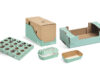
In fibre-based formats, the consortium said it had developed compostable packaging structures with barrier performance comparable to fossil-based plastics, citing applications such as trays and ice cream cups. This part of the programme reached TRL 7, according to the project, and is intended to offer packaging users an option that combines fibre-based construction with compostability and barrier functionality.
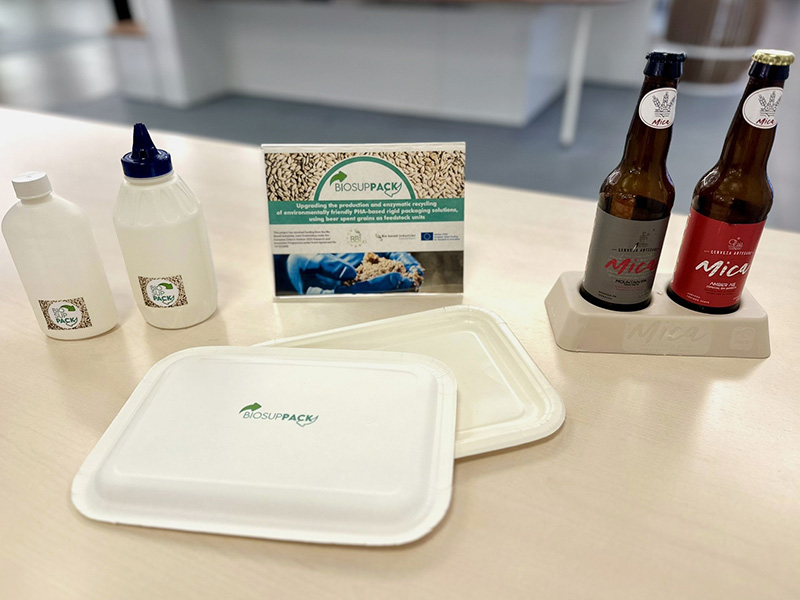
Rigid packaging was another focal area. BioSupPack said SABIOMATERIALS developed PHB-based formulations for bottles and retail displays, with the materials designed for extrusion blow moulding and injection moulding. The consortium described the materials as fully biodegradable and suitable for both mechanical and enzymatic recycling. These formulations also reached TRL 7, with industrial-scale production reported.
Prototype packaging applications were produced within the project, including bottles for dressings and personal care products developed by ILAB, alongside a beer bottle display for the retail sector produced by AIMPLAS. These demonstrators appear intended to show that the materials can be processed into formats relevant to both food and non-food packaging markets.
Beyond material and packaging development, BioSupPack also worked on waste management infrastructure for these new material streams. IRIS developed a sorting prototype intended to recover the novel bio-based packaging fractions for subsequent enzymatic recycling, while the project also reported progress in selective enzymes for that recycling route. This is a notable point in the context of current packaging regulation, where recyclability claims are increasingly tied not only to intrinsic material properties but also to the practical availability of collection, sorting and recovery systems.
That regulatory angle is central to the project’s positioning. BioSupPack said its results are directly relevant to the packaging sector’s transition under PPWR, particularly as companies prepare for more stringent recyclability and sustainability requirements. The consortium argued that the technologies can be integrated into existing manufacturing infrastructure, which would lower technical and economic barriers to adoption.
The project also framed its work within wider European industrial policy, linking its outcomes to the European Green Deal, the EU Bioeconomy Strategy and the Clean Industrial Deal. In practical terms, the message is that industrial waste streams such as brewery residues could support new packaging value chains while reducing dependence on fossil-based raw materials.
For packaging converters, material developers and brand owners, the significance of BioSupPack lies less in a single packaging launch than in the attempt to connect feedstock sourcing, polymer development, converting performance and end-of-life management within one coordinated system. Whether those technologies move into broader commercial deployment will depend on economics, processing performance and downstream market acceptance. But the consortium is now presenting the work not as a lab concept, but as a set of technologies ready for uptake by industrial stakeholders.